Interest matching
Shared-context discovery
Interests alone say little about the transition home. Shared experiences give people a more specific reason to discover one another.
Finding connection.
Rebuilding belonging.
A social product for returning international students rebuilding connection and belonging after moving home.
Original UI exports by Peiyi Yu. Screen copy and numbers are part of the design concept, not reported research or product outcomes.
Returning home can mean rebuilding a social circle. Reverse culture shock shaped three principles for Reroot.
Shared experiences give discovery a more meaningful starting point than surface-level interests alone.
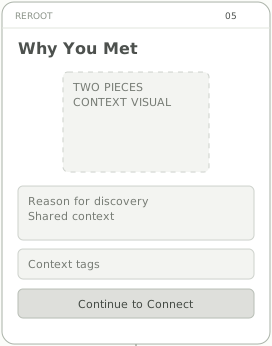
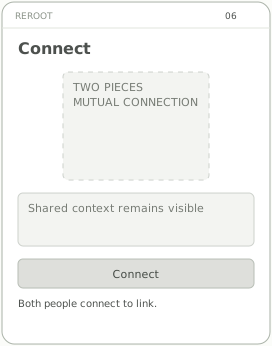
Explain why two people meet, then offer a gentle way to take the first step.
Help a connection grow into a local circle, shared city life and opportunities to meet offline.
Exploring emotional interfaces, social mapping and character-based identity systems.
From finding a person to finding a place in a community.
Interests alone say little about the transition home. Shared experiences give people a more specific reason to discover one another.
A match needs an explanation. Making shared context visible gives the first approach a starting point.
A single connection is only a beginning. The product extends toward ongoing circles and shared local experiences.
Six steps connect personal identity, shared context and local belonging.
Express the experiences you bring home.
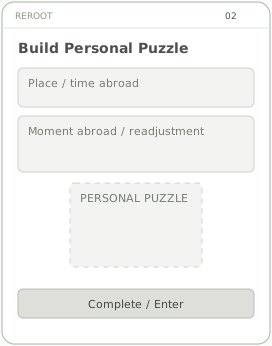
Find someone through shared context.
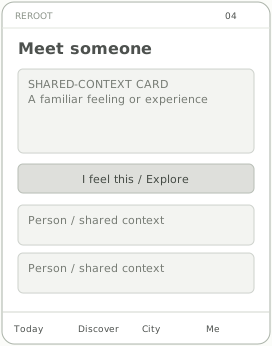
See what connects your experiences.
Take a mutual step toward connection.
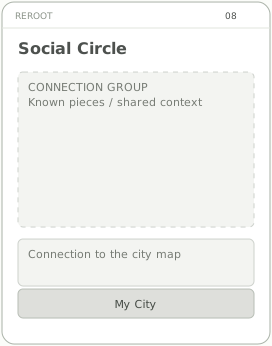
Place growing connections in local life.
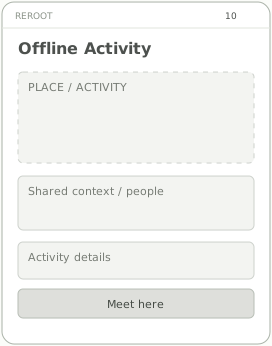
Continue the connection in person.





The existing screens connect questions about living abroad and returning home with a personal puzzle piece.
The core journey is presented through the original exported screens.
Onboarding and reflection introduce the personal puzzle metaphor.
Today, matching and shared interaction connect the individual story to another person.
The connection is represented as a shared shape, then placed within the personal and city maps.
This chapter is reserved for the testing process and documented changes.
Protocol, tasks and participant information to be supplied.
Original notes and findings to be supplied.
Before-and-after exports with the reason for each change to be supplied.
No testing results or usability improvements are claimed here.
The supplied interface includes a paid shared-intersection unlock. This is a proposed product mechanic, not evidence of revenue or demand.
Document the intended free and paid experience, value proposition and pricing assumptions.
Add evidence for willingness to pay, feasibility and other commercial assumptions when available.
A complete view of the supplied interface set. Select a screen to inspect the original export.
These are the supplied design screens. Research validation and commercial outcomes remain to be documented.